How to Protect Yourself from Bots, Scammers, and Fake Profiles


At some point, almost everyone has had the experience.
A message that feels slightly off. A profile that seems real—but not quite. A conversation that escalates too quickly.
And then the realization:
This person may not be real.
The New Reality
The internet has changed.
It’s no longer just people interacting with people.
It’s:
- Bots pretending to be humans
- Scammers building believable identities
- AI systems capable of holding full conversations
- Fake profiles designed to gain trust quickly
And the uncomfortable truth is:
Many of them are very convincing.
Why It’s Getting Harder to Tell
In the past, fake profiles were easy to spot.
Poor grammar. Stock photos. Obvious scripts.
That’s no longer the case.
Today, bad actors can:
- Generate realistic photos
- Mirror natural conversation patterns
- Study your behavior and adapt
- Build entire backstories
The line between real and fake is fading.
Which means:
You can’t rely on intuition alone anymore.
The Cost of Getting It Wrong
When you trust the wrong person online, the consequences can be serious.
People are losing:
- Money
- Time
- Personal information
- Emotional trust
In some cases, the damage goes far beyond financial loss.
So What Can You Do?
Protecting yourself online doesn’t require paranoia.
But it does require a shift in how you think.
Here are practical ways to reduce your risk:
1. Slow Down
Scammers rely on urgency.
They push for:
- Quick decisions
- Immediate trust
- Fast escalation
If someone is rushing you, that’s a signal.
Real people don’t need to rush trust.
2. Watch for Inconsistencies
Even the most convincing fake identities slip.
Look for:
- Details that don’t quite line up
- Changes in tone or behavior
- Vague or evasive answers
Small inconsistencies often reveal bigger problems.
3. Avoid Moving Too Fast Off Platform
Many scams follow a pattern:
- Start on one platform
- Quickly move to another (text, WhatsApp, Telegram, etc.)
Why?
Because it reduces oversight and increases control.
If someone pushes to move too quickly:
Pause. Ask why.
4. Be Careful What You Share
Until you trust someone, limit:
- Personal details
- Financial information
- Sensitive conversations
Trust should be built—not assumed.
5. Use Real-Time Verification
If you’re unsure about someone:
Ask them to verify themselves in real time.
This can be as simple as:
- A quick live video
- A shared moment that can’t be pre-recorded
- Something spontaneous and unpredictable
Why this works:
AI and fake profiles struggle with live, unscripted interaction.
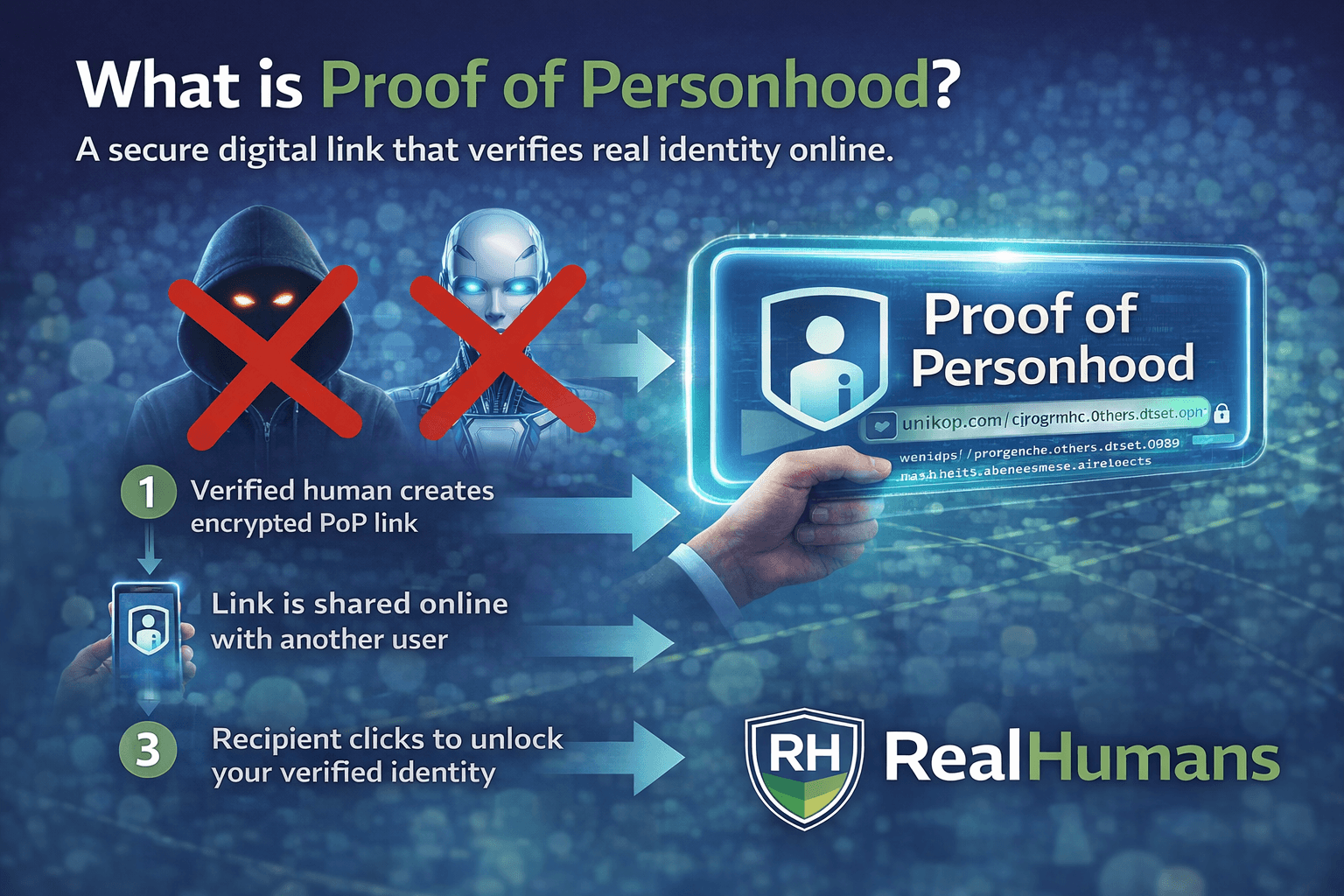
6. Require Proof of Personhood
The most reliable way to know someone is real is simple:
Ask them to prove it.
This is where RealHumans comes in.
As a verified RealHuman, you can create and share encrypted Proof of Personhood (PoP) links.
PoP links prove two critical things:
- You are a real human—not an AI system or bot
- You are the real human you claim to be
This changes the dynamic immediately.
Most online fraud depends on anonymity. Scammers rely on the fact that you don’t know who they really are.
But when someone is asked to prove their real identity:
The risk shifts.
Real people—whose identities are known—are far less likely to commit fraud. And fraudsters know it.
That’s why they avoid situations where identity is verified.
By requiring a PoP link, you’re not just asking, “Are you real?” You’re asking:
“Are you willing to prove it?”
And that simple question filters out a large percentage of bad actors.
If you want to reduce your risk online, make this a habit:
Exchange PoP links before you trust.
A Simple Shift
The biggest change isn’t technical—it’s behavioral.
Instead of asking: “Do they seem real?”
Start asking: “Have they proven they’re real?”
Why This Matters
As AI continues to improve, the number of fake identities online will increase.
Not decrease.
Which means the burden shifts to us:
To be more thoughtful. More intentional. More aware.
The Future of Trust
We believe the future of the internet will include a simple expectation:
If you want to interact, transact, or build trust online…
You must be able to prove you’re real.
You don’t need to be paranoid.
But you do need to be prepared.
Because in a world where anyone can appear real…
The safest path is knowing who actually is.